unnamed

Acting AG Bruck: New Jersey Supports Adoption of Stronger Federal Protections against Worker Misclassification

For Immediate Release: February 10, 2022
Office of The Attorney General
Andrew J. Bruck, Acting Attorney General

TRENTON – Acting Attorney General Andrew J. Bruck announced today that New Jersey is co-leading a multistate effort to support the adoption by the National Labor Relations Board (NLRB) of stronger protections for workers whose employers would misclassify them as independent contractors — a designation that can deprive workers of wages earned, core workplace benefits and the ability to organize.

In an amicus brief filed with the NLRB today, New Jersey urges the Board to adopt a more worker-protective standard for determining whether a worker is an employee protected by federal labor laws safeguarding the right to organize and collectively bargain, or, in the alternative, an independent contractor not covered by such legal protections.

Acting Attorney General Bruck is co-leading today’s multi-state amicus brief to the NLRB along with Pennsylvania Attorney General Josh Shapiro. A total of 14 other Attorneys General have signed onto the brief, which describes misclassification as a burgeoning problem that harms both workers and states, and asserts that “this is not the time to weaken protections” against the employer tactic.

“Here in New Jersey, we care about workers’ rights,” said Acting Attorney General Bruck. “Workers who are misclassified as independent contractors end up suffering a whole host of disadvantages – including substandard wages, denial of workplace safety protections, denial of employment benefits they rightfully deserve and, crucially, the right to fight for improved working conditions by organizing and collectively bargaining.”


(Read More)

Project labor agreements on federal construction projects will benefit nearly 200,000 workers

Posted February 9, 2022 at 11:07 am by Ihna Mangundayao, Celine McNicholas, and Margaret Poydock

President Biden recently signed an executive order (EO) requiring project labor agreements on federal construction projects over $35 million, a move that is expected to affect $262 billion in federal construction contracting and improve job quality for nearly 200,000 workers.

Project labor agreements (PLAs) are used primarily in the construction industry to establish the terms of employment for all workers on a project. Generally, PLAs specify workers’ wages and fringe benefits and may include provisions requiring contractors to hire workers through union hiring halls, otherwise establish a unionized workforce, or develop procedures for resolving employment disputes. PLAs often include language that prevents workers from striking during the project while also preventing employers from locking workers out.

PLAs are effective mechanisms for controlling construction costs, ensuring efficient completion of projects, and establishing fair wages and benefits for all workers. PLAs also help ensure worker health and safety protections while providing a unique opportunity for workforce development. These agreements can be written to engage local populations, provide jobs for underrepresented groups, and develop experience for apprentices.

Project labor agreements don’t raise construction costs

Evidence shows that PLAs do not increase construction costs. For example, New York City embarked on a $5.3 billion project in 2009, and the use of four PLAs was estimated to lead to 1,800 new jobs while saving the city approximately $300 million. A study from the Berkeley Labor Center also found that projects with PLAs attracted a “similar number of bidders” and “came in at a slightly lower price” when compared to projects without PLAs in place. Another 2015 paper from University of Utah economists compared nine PLA affordable housing projects with 121 affordable housing projects built without PLAs and found that the PLA projects were not more expensive to build.

(Read More)

(White House Briefing)

unnamed

Mills administration cracking down on employer wage and hour violations

BY PETER MCGUIRE | STAFF WRITER
February 6

The state Department of Labor returned about $470,000 in unpaid wages to Maine workers in 2021, almost double the amount in 2019. Now it is naming violators online.

Since Gov. Janet Mills took office three years ago, the Maine Department of Labor has escalated its pursuit of illegal workplace practices including wage theft, child labor and false record keeping, a significant departure from past practices at the agency.

The number of inspectors at the department’s Wage and Hour Division has doubled. The amount of unpaid wages recovered for workers has skyrocketed. In an unprecedented move, two employers have been shut down permanently for wage theft. And now, the department will regularly publish business names and violation details in an online database.

Collectively, the changes reflect a shift in the department’s effort to find and resolve a serious offense against some of Maine’s most economically vulnerable workers. But labor advocates say a lot more could still be done.

“It is just a matter of trying to make the best use of limited resources to protect workers from abuses, and protect law-abiding employers from unfair competition that comes with employment law violations,” said Michael Roland, director of the state Bureau of Labor Standards. “We just felt we could be more effective given the resources we have.”

In 2018, there were just four inspectors working at the bureau. As of this year, it has nine inspectors and an assistant attorney general specifically tasked with pursuing wage and hour cases.

(Read More)

Biden joins ironworkers in Upper Marlboro to sign federal labor protections into law

Joshua Barlow
February 5, 2022, 10:32 PM

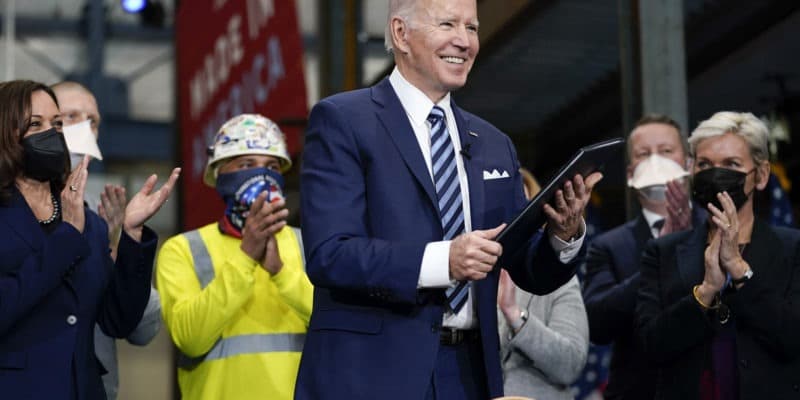
President Joe Biden joined union members at Ironworkers Local 5 in Upper Marlboro, Maryland, where he signed an executive order that gives construction workers new protections for federally contracted projects.

According to the White House, the executive order requires federal construction contracts worth more than $35 million to use project labor agreements.

The order, which goes into effect immediately, will affect an estimated 200,000 union workers in an industry that has taken severe economic hits due to the pandemic.

Project labor agreements (PLA) are legal mechanisms by which the terms and conditions for workers on an individual project are determined. Within the new executive order, any contractor who is awarded a federal contract must co-sign the PLA with any union representing their labor force.

(Read More)

FACT SHEET: President Biden Signs Executive Order to Boost Quality of Federal Construction Projects

White House Briefing Room
FEBRUARY 03, 2022 | STATEMENTS AND RELEASES

Biden-Harris Administration will make federal procurement more economical and efficient by improving coordination and minimizing disruptions on large federal construction projects

Tomorrow, the President will sign an Executive Order to improve timeliness, lower costs and increase quality in federal construction projects. Federal construction projects span the country – from the maintenance of nuclear sites to base construction to waterways and flood projects. By requiring the use of project labor agreements (PLAs) on federal construction projects above $35 million, the Order will help alleviate the management and coordination challenges that can stymie progress on major construction projects. This helps projects get completed on time and helps the government get the best value for taxpayers’ dollars.

Based on FY2021 figures, this Order could affect $262 billion in federal government construction contracting and improve job quality for the nearly 200,000 workers on federal construction contracts. Additionally, the President’s Executive Order directs the departments of Defense and Labor, along with the Office of Management Budget, to lead a training strategy for the nearly 40,000-person strong contracting workforce on the implementation of this Order’s policy.

This Executive Order is just one of many steps the Biden-Harris Administration is taking that will improve the efficiency of federal procurement. Since taking office, the President fulfilled his commitments to strengthen Buy American rules, and secured a reliable supply of experienced, quality workers for federal service contracts. As of January 30th, federal contractors in new or extended contracts must pay a $15/hour minimum wage, as the President directed in Executive Order 14026.

This new Executive Order, while only applicable to federal procurement, advances the Administration’s commitment to rebuild the nation’s infrastructure, on-time and at reasonable cost. The Order will only apply to provisions in the Bipartisan Infrastructure Law that are direct federal procurement, which excludes construction projects financed through grant dollars to non-federal entities. The Executive Order will benefit taxpayers, contractors, and workers by:

  • Alleviating the coordination challenges on large, complex projects. Multi-million-dollar projects can present real management challenges to the primary contractor on the project, which has to work with multiple businesses and multiple types of skilled labor to complete a project. PLAs can help coordinate diverse contractors and sub-contractors and their employees working on a project and prevent disputes between subcontractors. Additionally, workers will have more confidence in the management of the project and a greater commitment to completing the project if they have a voice at the table. This helps projects get completed on time by minimizing work disruptions. On-time projects save the government, and taxpayers, money.
  • Raising quality standards for contractors bidding on federal projects. PLAs help raise the standards of all bidders on federal contracts. Contractors who offer lower wages or do not train their workers will need to raise their standards to compete with other high-wage, high-quality companies. Businesses with well-trained workers will be more likely to bid for and win federal contracts. Well-trained, high quality workers are more productive, completing projects well and on time.
  • Reducing uncertainty in the contracting process. PLAs standardize the work rules, compensation costs, and dispute settlement processes on construction projects. This standardization helps create more certainty for the government and, therefore, taxpayers, about the costs and completion rate for projects.
  • Increasing training for the federal contracting workforce. The Executive Order directs the Departments of Defense and Labor, along with the Office of Management and Budget, to lead a training strategy for the contracting workforce on Project Labor Agreements and the implementation of this Order. This training will create a more uniform and accessible experience for contractors interacting with departments and agencies across the federal government.

(See White House Briefing)

(See Official White House Presidential Action on PLAs) released Feb. 4, 2022

The Deadline is Here for Federal Contractors to Start Paying at least $15 an Hour

January 31, 2022
Courtney Buble

This comes as a “record number” of states and localities are increasing their minimum wages in 2022.

President Biden’s $15 hourly minimum wage for employees of federal contractors officially took effect on Sunday.

Biden announced this initiative shortly after taking office in January 2021, then followed up with an executive order in April. The final regulation, which was issued in November, will be indexed for inflation. It also eliminates the tipped minimum wage for federal contractors by 2024, ensures workers with disabilities don’t earn a sub-minimum wage and protects outfitters and guides working on federal lands, reversing a policy from the Trump administration.

“The $15 minimum wage required by Executive Order 14026 applies only to contracts entered into, renewed or extended (pursuant to an exercised option or otherwise) on or after Jan. 30, 2022,” Labor Department spokesperson Edwin Nieves told Government Executive on Thursday. “Despite recent litigation, the DOL is proceeding with the implementation of [the executive order].”

Government Executive reported on one legal challenge in December. The U.S. District Court for the District of Colorado denied the plaintiff’s request for a preliminary injunction on the rule on Jan. 24 and they appealed that decision last Wednesday.

“Contracting agencies will need to take appropriate implementing steps to ensure that covered contracts comply with the executive order’s requirements by, for example, incorporating the relevant contract clause into covered contracts,” Nieves continued.

(Read More)

unnamed

Council moves to put a stop to wage theft

FRIDAY, JANUARY 28, 2022
BY JO CLIFTON

Austin is taking a step toward joining El Paso and Houston in punishing employers that engage in wage theft, with a resolution City Council approved unanimously on Thursday. A dozen people signed up to tell Council members to approve the resolution, which was sponsored by Council Member Ann Kitchen.

The resolution directs City Manager Spencer Cronk to create a system for the city to receive complaints from workers about construction employers who fail to pay wages owed to employees, fail to maintain payroll records or improperly classify employees as independent contractors. Staff members are expected to come back to Council with an ordinance establishing criminal penalties and a civil complaint procedure relating to wage theft. …

District Attorney José Garza sent a letter to the mayor and Council urging them to approve the resolution. He noted that his office has launched an economic justice enforcement initiative, with some emphasis on deterring wage theft. However, he wrote, “As we have undertaken this initiative, it has become clear to us that there are not sufficient systems in place to support wage theft victims or deter these legal violations from recurring. We need additional partners in this work. I am hopeful that this resolution presents an opportunity for our office to deepen its collaboration with the city and strategize how we can strengthen avenues available for wage theft victims to seek justice.”

(Read More)

U.S. Labor Agencies Strike Deal to Share Enforcement Information

Jan. 6, 2022
Bloomberg Law

  • Agreement involves Labor Department, federal labor board
  • Effort targets cases involving misclassification, retaliation

The U.S. Department of Labor’s wage regulator and the National Labor Relations Board have struck an agreement to collaborate on investigations and share information on potential violations of law, specifically targeting independent contractor misclassification and retaliation against workers.

Their new memorandum of understanding, made public Thursday, will create a formal referral process for violations of federal labor and employment laws, making it easier for the government to pursue employers who have breached laws enforced by both agencies, Jessica Looman, acting administrator of the DOL’s Wage and Hour Division, said in an exclusive interview.

“This MOU allows us to have that formal referral process back and forth between the two agencies, so that we can help the worker get to the place where they need to be and have their rights enforced, as opposed to relying on the worker to have to try to navigate the government system on their own,” Looman said.

The agreement will take effect immediately at the WHD. Looman said the agency will review its current investigations for cases that may have potential overlap with the federal labor board.

The NLRB and the WHD will work together to create a system to share information in an effort to “maximize” and “improve” enforcement, according to the agreement, which was signed in early December.

(Read More)

unnamed

Pennsylvania returns over $3.5 million in wages to wronged workers in 2021

Monday, January 3rd 2022
By Kurt Martone

HARRISBURG, PA. (WENY) — The Pennsylvania Department of Labor and Industry investigated over 4,000 alleged labor law violations requested from Pa. workers in 2021. The department returned over $3 million worth of missed wages to workers across the Commonwealth.

“Pennsylvania workers are entitled to every dollar they earn, and that’s why the department’s Bureau of Labor Law Compliance works so hard to hold employers accountable when they wrongfully withhold wages or violate any of Pennsylvania’s labor laws,” said Jennifer Berrier, secretary of the Pennsylvania Department of Labor and Industry.

WENY reached out to the Department of Labor and Industry to find the amount of lost wages given to residents of Bradford and Tioga counties.

Since 2015, the department has collected over $38 million in unlawfully held wages for workers in Pennsylvania.

BY THE NUMBERS:

The bureau returned over $2 million to workers employed by 900 employers in violation of the Wage Payment and Collection Law.

One million dollars was returned to workers whose employers violated the Prevailing Wage Act.

The other, over $500,000, in missed wages was returned to workers whose employers violated the Minimum Wage Act.

(See Article)

3d_money_construction_dreamstime_xxl_21903206

AG’s Office accuses Framingham companies of underpaying workers of public projects

Zane Razzaq
MetroWest Daily News
Dec. 29, 2021

FRAMINGHAM — A Hollis Street construction company and its owners will be fined more than $540,000 over allegations they failed to pay prevailing wages to employees who worked on public projects at the Middleborough and Westport police stations, according to the Attorney General’s Office.

Superior Carpentry Inc. and its president, Fernando Barroso, and vice president, Felipe Drumond, were issued five citations by Attorney General Maura Healey’s office for failing to pay prevailing wages, not submitting accurate payroll records and falsifying records, according to a press release.

Another Framingham company, BPI Construction Management Inc. on 110 Mill St., also received a separate complaint from the office alleging it knowingly facilitated the submission of fraudulent payroll records.

BPI subcontracted the work to Superior Carpentry.

“These companies cheated workers out of the wages they earned while working on public construction projects and then repeatedly lied about it to the municipalities involved,” said Healey in a statement. “Contractors and constructions companies at every level, in every trade, are responsible for performing their work in accordance with the law. It is a priority of our office to ensure that workers are paid the wages owed to them.”

(Read More)