

STUDY: UNIONIZATION FELL LAST YEAR, BUT ILLINOIS’ MIDDLE CLASS STILL DEPENDS ON UNIONS

For Immediate Release: September 2 2019
Contact: Frank Manzo IV, 708-375-1002, fmanzo@illinoisepi.org

Chicago: On Labor Day 2019, researchers from the Illinois Economic Policy Institute, University of Illinois at Urbana-Champaign, and University of California, Irvine released the sixth annual State of the Unions report for Illinois. The study finds that unions play an important role in Illinois’ economy communities, despite declining union membership over the past decade.

Read the entire report, The State of the Unions 2019: A Profile of Unionization in Chicago, in Illinois, and in the United States, here.

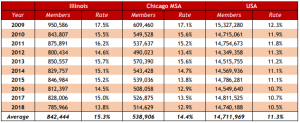
Since 2009, Illinois’ union membership rate has declined by 2 percentage points. After a one-year uptick, Illinois’ unionization declined from 15.0% in 2017 to 13.8% in 2018. Unionization decreased in the Chicago metropolitan area by about 12,000 members over the year.
 

“Labor unions have recently faced many legislative and judicial setbacks including the Supreme Court decision in Janus v. AFSCME, which may have affected unionization rates,” said Professor Robert Bruno, who serves as Director of the Project for Middle Class Renewal at the University of Illinois at Urbana-Champaign.

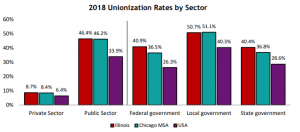
However, public sector workers continue to have high rates of union density. About half of all public sector workers are unionized in both Illinois (46.4%) and the Chicago metropolitan area (46.2%) as of 2018, exceeding the national public sector unionization rate (33.9%). In comparison, fewer than one-in-ten private sector workers (8.7%) are now union members in Illinois.

Despite declines in union membership, the report concludes that labor unions boost worker incomes by lifting hourly wages by an average of 11%. In addition, the authors find that African Americans, military veterans, and rural workers are disproportionately more likely to be union members in Illinois.

“Unions raise wages for everyone, but especially for low-income and middle-class workers,” said Frank Manzo IV, Policy Director of the Illinois Economic Policy Institute. “Unions reduce inequality, provide family-supporting careers for our nation’s heroes, and foster a strong middle class in communities across Illinois.”


(Visit ILEPI’s Website)

(See PDF of Study)

dispatcher-12

SWACCA President to Testify Before House Committee on Misclassification in the Construction Industry

Business Wire
September 25, 2019 11:22 AM

WASHINGTON – On Thursday, Sept. 26, at 10:15 a.m. EDT, Matt Townsend, the President of the Signatory Wall and Ceiling Contractors Alliance (SWACCA) and Chief Executive Officer of OCP Contractors, Inc., located in Holland, Ohio, is scheduled to testify before the U.S. House of Representatives’ Committee on Education and Labor Workforce Protections Subcommittee at a hearing titled Misclassification of Employees: Examining the Costs to Workers, Businesses, and the Economy

In his testimony, Townsend will outline how the misclassification of employees impacts the construction industry, particularly the competitive disadvantage it creates for law-abiding employers.

“SWACCA appreciates the opportunity to highlight for Members of Congress the pervasiveness of employee misclassification in the construction industry,” said Townsend. “Law-abiding employers like the ones SWACCA represents do not wish to be complicit in misclassification in order to compete. I look forward to sharing with Congress exactly how these misclassification schemes tilt the playing field against law-abiding employers in the construction industry while also harming workers and taxpayers.”

SWACCA has established itself as a leader in the fight against misclassification in the construction industry. Last Congress, SWACCA strongly opposed passage of legislation that would have eliminated barriers to misclassifying workers as independent contractors. A letter submitted on behalf of SWACCA opposing passage of the bill was cited in a House Committee report and on the floor of the House of Representatives during debate. SWACCA also fought to ensure that an IRS rulemaking initiated by the passage of the 2017 tax reform legislation did not create a financial incentive for workers to accept being misclassified in exchange for a favorable “pass-through” tax deduction.

The Misclassification of Employees: Examining the Costs to Workers, Businesses, and the Economy hearing will take place in the House Education and Labor Workforce Protections Subcommittee on Thursday, Sept. 26 at 10:15 a.m. EDT in the Rayburn House Office Building Room 2175. A livestream will be available here.

The Signatory Wall and Ceiling Contractors Alliance (SWACCA) is a national organization of signatory wall and ceiling contractors committed to working in partnership with its workforce to provide the highest-quality, most efficient construction services possible to its customers. SWACCA prides itself on representing companies that fully embrace their commitment to their customers and their employees.

(Read More)

Building better communities through construction workforce development

PUBLISHED – Sept. 23, 2019

A Growing Workforce Trend

More and more often, public agencies are incorporating workforce hiring requirements into their construction contracts. For those who are unfamiliar, these stipulations typically require the contractors that are awarded contracts by the agency to employ a workforce that meets certain thresholds of demographic criteria. For example, one of the more common trends that local entities push for is an increased rate of local hires.

Typically, the contracting agency sets a benchmark on a project that the contractors must meet. In this example, contractors must maintain that a certain percentage of the workers on the project must reside within the city or county in which the project takes place (alternatively, the percentage of total hours worked on the project can be used as a measure). The primary motive of the agency here would be to ensure that the residents of the community are the ones benefiting most from public funds used on this project to maximize the return on taxpayer dollars. This discourages the outsourcing of skilled labor, a not-so-uncommon tactic that some contractors might try in order to cut recruiting and hiring costs. (Remember, the use of local labor is one of the reasons the Davis-Bacon Act was created in 1931.) The benefit that the public entity realizes from these hiring requirements is compounded. Not only are stable career opportunities created for local residents, but the workers’ disposable income may contribute to the local economies and provide additional tax revenue that would have otherwise been displaced along with the transplanted workers once the project was complete.

Another commonly tracked statistical measure that is vital to the longevity of the industry’s success is that of apprentices or on-the-job trainees (OJTs). These recruits are crucial because of the industry’s dependency on new labor entering the market. As many government professionals might already be aware, one of the most common obstacles contractors face daily is obtaining and retaining a sufficient quantity of skilled labor to complete their projects on time and on budget. It has been no secret that the industry has struggled to replenish voids left by retiring workers as socio-economic pressures have increasingly influenced youth to pursue college degrees and white-collar jobs over manual labor (even despite its enticing stability and benefits). This obstacle, among a plethora of others, has kept the industry in a constant battle searching for new skilled labor to keep up with the demand for construction projects.

A New Opportunity

This struggle, however, has positioned the industry in a unique situation. In fact, many feel that this challenge has presented a potential goldmine opportunity. It has left the door open to target new sources of untapped potential in traditionally under-utilized pockets of demographics, giving industry players a chance to fill the labor deficit while also providing career opportunities to individuals who need them the most.

Some localities have taken these hiring requirements to the next level to address these under-represented communities like minorities, the economically impoverished, or other disadvantaged groups. By working together with workforce training programs and supportive services that cater to these individuals, various entities across the country have successfully made a difference in lifting up the most deserving members in their communities with stable careers.

(Read More)

Renewed Push Coming for Worker Misclassification Crackdown

by Scott Braddock | September 26, 2019

Later this year, Democrats in the US House of Representatives plan to restart their push to penalize companies that compensate their workers as independent contractors when, by law, they should be classified as employees and compensated as such.

Of course, there are many legitimate uses of contract labor. But the issue arises when employers abuse the classification to skirt payroll taxes and benefits like health care and retirement plans.

Unscrupulous employers often use the practice to be able to submit much lower bids for projects, undercutting responsible contractors. Several states have already passed laws to penalize those who cheat workers and taxing agencies in this way. California is pressing ahead with major reforms and Texas, several years ago, passed a targeted crackdown on misclassification on taxpayer-funded construction.

Bloomberg has more on the new push by House Democrats in Washington:

The bill comes as Uber, Lyft, and other gig economy companies have been embroiled in legal disputes over their classification of workers as independent contractors. That designation means the workers aren’t protected by minimum wage and overtime pay requirements, don’t have the right to unionize, and aren’t eligible for workers’ compensation and unemployment insurance benefits.

Gig companies recently led an unsuccessful lobbying blitz against a new California law that makes it harder to classify workers as contractors.

Classification questions have also plagued construction and a wide range of other industries.

Previous versions of the bill would have amended the Fair Labor Standards Act to require employers to accurately classify workers and double the liquidated damages for unpaid wages owed to those wrongly treated as contractors. The bill also would have banned businesses from retaliating against workers for challenging their classification.

Here is a copy of the bill as proposed.

(See Article)

INSIGHT: Employment Tax Fraud in Construction-How to Avoid Accidentally Crossing the Line

Sept. 13, 2019, 9:01 AM

Tax fraud in the construction industry has caught the attention of federal and state tax authorities across the nation. Recently, a Long Island construction business owner failed to pay nearly $1 million in payroll tax withholdings and now faces a maximum five year prison sentence.

Although most employers do not intentionally break the law, employment tax compliance is often a focus for tax authorities, and in addition to incarceration of responsible persons, construction companies can face thousands of dollars in penalties for failure to comply with tax laws. Construction businesses can reduce the risk of an audit by understanding employment tax rules and avoiding common pitfalls.

Employment Tax Basics

Construction companies, like most businesses, are generally required to withhold from their employees’ paychecks and pay to the IRS federal employment taxes. The term “employment taxes” generally is used by the IRS to refer to:

  • Amounts withheld from employees’ paychecks for federal income taxes;
  • Amounts withheld from employees’ paychecks for Federal Insurance Contribution Act (FICA) taxes, which are Social Security and Medicare taxes that are matched by amounts employers are required to contribute for Social Security and Medicare; and
  • Federal Unemployment Tax Act (FUTA) taxes, which are taxes paid by employers into workers’ compensation and unemployment funds.

These taxes are commonly referred to as “trust fund” taxes because the money withheld is being held in trust by the employer for the benefit of government. Employers generally must electronically deposit theses taxes with the IRS either monthly or semiweekly and file a Form 941 or 944. The IRS’s employment tax rules can be found in IRS Publication 15. State employment tax laws vary by jurisdiction and construction companies should consider any local laws as well

(Read More)

XPO reaches $5.5M misclassification settlement (CA)

AUTHOR: Matt Leonard
PUBLISHED: Aug. 22, 2019

Dive Brief:

  • XPO Logistics has reached a settlement with 3,772 plaintiffs in a case accusing the company of breaking California labor laws by requiring the plaintiffs to work off-the-clock without pay, failing to pay overtime and other allegations, according to a motion for settlement approval filed this past Friday by the plaintiffs.
  • The $5.5 million settlement will result in an average payout of $935.18 for each plaintiff, 1,981 drivers and 1,791 helpers, according to court documents filed in the U.S. District Court of the Northern District of California court this week.
  • The plaintiffs have requested the settlement be given preliminary approval and for the court to set a date for the final approval hearing. A proposed schedule filed by the plaintiffs lists Sept. 4 as the potential date for the preliminary approval hearing.

Dive Insight:

XPO will sometimes contract with other carriers to provide last-mile delivery services. The plaintiffs in this case were drivers and helpers for these contract carriers who allege XPO is the lawful employer in these situations because it had “extensive and pervasive control over the drivers’ and helpers’ workday,” according to the settlement documents.

The original complaint outlines various California labor laws the plaintiffs accused XPO of not abiding including unpaid overtime, not paying minimum wage, depriving contract workers of meal and rest periods, and failing to pay wages in a timely manner.

The plaintiff, who accepted the settlement on behalf of the class, was willing to settle because he “recognizes the risk that the Court may determine Plaintiff and the putative class were not employees of XPO,” the settlement documents read.

XPO argues that even if it was considered an employer it would be a co-employer with the contract carriers.

(Read More)

unnamed

Iron Workers Union announces $300,000 Wage Theft Settlement for Millennium Reinforcing Workers (CA)

NEWS PROVIDED BY
Ironworkers California & Vicinity District Council
Oct 21, 2019, 13:12 ET

LOS ANGELES, Oct. 21, 2019 /PRNewswire/ — Millennium Reinforcing Inc. (MRI) has settled a $300,000 class action lawsuit filed by employees of the company with the assistance of the Ironworkers California & Vicinity District Council. All Class Members are current or former hourly non-exempt iron workers employees of MRI who were victims of wage-theft by the company. As of September 23rd, 2019, 73 Class Members for the Perez v. Millennium Reinforcing Settlement case-including the class representatives Angel Leon and Alfredo Perez will receive checks from the settlement.

The Ironworkers Union has been assisting workers at Millennium Reinforcing, a California concrete reinforcing contractor, to improve working conditions at the company. During their struggle, workers stated they were subjected to a number of unjust conditions. Faced with wage violations, poor safety and working conditions, Millennium workers felt their only option was to fight for changes at the company.

Ironworker California & Vicinity District Council President and General Vice President Don Zampa said, “The Ironworkers Union has a long history of helping to improve conditions for all workers in our industry, regardless of race, creed, color, gender, national origin or Union affiliation. We have proudly stood beside the Millennium workers in their struggle for better treatment, pay, safety and working conditions from their employer. We are very satisfied with the outcome of the Settlement and happy our collective efforts have benefited workers for Millennium and their families. We will continue to provide assistance for MRI workers on issues they may bring to us in the future as well.”

(Read More)

Granite Receives Two APWA 2019 Public Works Project of the Year Awards (CA)

By: Business Wire
August 16th, 2019 , 08:30 AM

WATSONVILLE, Calif.–(BUSINESS WIRE)–Granite (NYSE:GVA) announced today that it was recently selected as the recipient of two American Public Works Association’s (APWA) 2019 Public Works Project of the Year Awards for infrastructure projects publicly developed, owned, and maintained, that promote excellence in construction management and administration. These awards recognize the alliance between the managing agency, the contractor, the consultant, and their cooperative achievements.

Granite received APWA’s 2019 Public Works Project of the Year Award for the SouthEast Connector, Phase 2 project in the transportation category, projects of more than $75 million division. As part of the SouthEast Connector, Phase 2 project, Granite built the newly dedicated Veterans Parkway to connect large residential and commercial areas via a 5-mile, 6-lane arterial highway featuring 10 bridges and 17 precast multicell box culverts. Granite also constructed a multiuse pathway for cyclists and pedestrians, as well as sound walls and new signalized intersections avoiding impact to the surrounding wetlands and tributaries of the Truckee River. The team created 150 acres of new wetlands, sequestered mercury-contaminated soils, removed hundreds of acres of noxious weeds, and disposed of 2000 tons of trash.

Tangerine Corridor Constructors (TCC), a joint venture between Granite and Borderland Construction, received APWA’s 2019 Public Works Project of the Year Award for the Tangerine Road: Dove Mountain Boulevard to La Cañada Drive project in the transportation category, projects of $25 million to $75 million division. TCC reconstructed approximately five miles of two-lane roadway to four lanes of divided roadway, along with widening and improvements to four major cross-streets. The project also included four signalized intersections, a new multi-use path, extensive drainage upgrades including 42 cross drainage structures to enable all-weather access, five underground wildlife crossings, significant native plant preservation, and native landscaping.

The APWA Public Works Projects of the Year Awards are given in four divisions and five categories. The divisions are: projects less than $5 million; projects of $5 million, but less than $25 million; projects of $25 million to $75 million; and projects of more than $75 million. The categories are: structures: transportation; environment; historical restoration/preservation; and disaster or emergency construction repair.

(See Article)

unnamed

Crackdown on labor crimes in region intensifies (CA)

By Heather Yakin
Posted Oct 17, 2019 at 6:22 PMUpdated Oct 17, 2019 at 7:55 PM

NEWBURGH – The battle against wage theft and other labor-related crimes is going regional, prosecutors and labor leaders said Thursday at Montefiore St. Luke’s Cornwall Hospital in Newburgh.

Orange County District Attorney David Hoovler ticked off some of the categories: prevailing wage fraud, failure to provide insurance or worker’s compensation, misclassifying workers in order to underpay them. Unscrupulous contractors who use those tactics can underbid ethical companies, putting the ethical people at a disadvantage, Hoovler said.

So when public works projects are put out to bid, he said, “I feel it’s my job to make sure local contractors, local bidders and local workers get a fair shake,” and to make sure workers get the right compensation and the employers pay their fair share of taxes.

According to the New York State Labor Department, in 2018 more than $35.3 million in fraudulently obtained money was returned to about 35,000 workers who had been the victims of wage theft or public work violations.

An undocumented worker who gets paid the wrong amount can’t seek help, said Alan Seidman, executive director of the Construction Contractors Association. And when an employer skimps on or skips insurance or worker’s compensation and an uninsured worker gets hurt on the job, taxpayers foot the medical bills.

Seidman talked about a case from about three years ago, on a project in the Town of Montgomery where an out-of-state contractor won the bid.

“A non-union ironworker from out of state, making probably $14 or $15 per hour, fell and ended up with a broken bone in his back,” Seidman said. “No one knew until he was wheeled in (to the hospital) that he had no insurance.”

The contractor fired the worker the same morning.

Hoovler said his goal is not necessarily to prosecute the offenders, some of whom aren’t aware of New York’s Labor Law requirements.

“We try to educate first, prosecute second, and ultimately get compliance,” he said. Wage theft, however, is a zero-tolerance matter.

(Read More)

dispatcher-12

On Labor Day, California workers need help to survive hostile U.S. Supreme Court (CA)

BY ELIZABETH STEELMAN
SPECIAL TO THE SACRAMENTO BEE
AUGUST 31, 2018 12:00 PM

While many politicians have committed to raising wages or combating wage theft and other workplace abuses, on this Labor Day we are living through a time in American jurisprudence that appears hell-bent on degrading the tools that workers rely on to enforce these commitments.

I am not just talking about the Janus ruling by the U.S. Supreme Court, which will weaken public-sector labor unions by forcing them to serve non-members for free.

Another controversial recent decision was the Epic Systems case, which effectively bars non-unionized workers from collective action and forces them to settle disputes through a mandatory arbitration process that’s controlled by the boss.

The Supreme Court deepened the power imbalance that exists between employer and employee, as if threats of retaliation don’t already prevent many workers from enforcing their rights.

In California, one in five construction workers is a victim of some form of wage theft. Generally, this means they were paid off the books, less than promised or not at all. This is about more than workers. Wage theft costs California taxpayers $8.5 billion every year and puts honest businesses at a competitive disadvantage.

Absent a union contract (which only cover about 20 percent of construction workers), a cheated worker’s best hope is some type of collective action or robust government enforcement. The Epic Systems ruling basically took the first option off the table.

To combat abuses such as wage theft, labor laws must be enforced. But only a fraction of victimized workers ever file claims and most wage theft judgments are never collected. The often lengthy and complicated process leads many workers to simply give up fighting a system they see as rigged.

States and municipalities can either accept this reality, or commit themselves to reclaiming the enforcement tools that courts have taken away from workers.

(Read More)