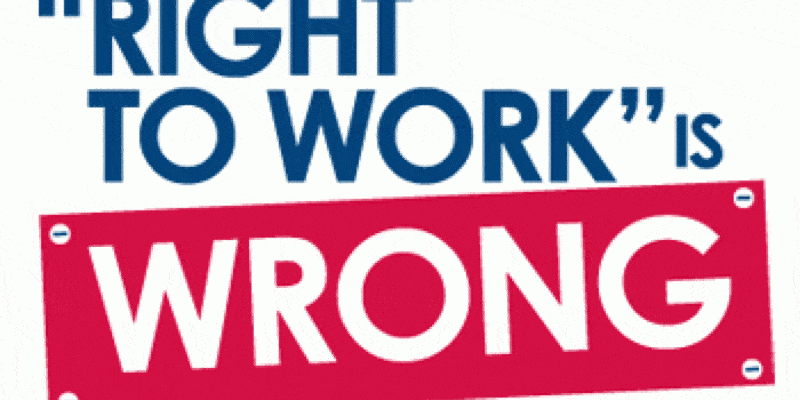
Missouri voters just blocked the right-to-work law Republicans passed to weaken labor unions (MO)

By: Alexia Fernández Campbell
August 7, 2018

It’s the first time voters have overturned right-to-work laws through a ballot referendum in recent years.

Missouri voters made history on Tuesday, blocking the state’s Republican lawmakers from enacting right-to-work laws to cripple labor unions. The state’s primary voters rejected Proposition A, which would have made it illegal for unions to charge fees to workers they represent who don’t want to pay them, by a two-to-one margin when the vote was called by Decision Desk around 10 pm Eastern.

Missouri was on track to become the 28th state to enact such a law. Last year, the state’s then-governor, Republican Eric Greitens, signed the right-to-work bill, saying that it would encourage businesses to move to the state. Missouri would have followed Michigan, Wisconsin, and other Rust Belt states that have passed similar anti-union measures in recent years under pressure from business groups.

But workers and union leaders in Missouri put up a fight. They gathered about 300,000 signatures – more than double the number needed – to freeze the law and put it on the ballot for voters to decide. On Tuesday, voters rejected the bill.

Tuesday’s election marks the first time voters have overturned a right-to-work law through a ballot referendum since Ohio did something similar in 2011. No other state has even tried to in recent years. It’s also a major victory for the US labor movement at a time when Republican leaders, big businesses, and the courts have doubled down on their attempts to weaken the influence of labor unions and the workers they represent. And after the US Supreme Court’s June ruling in Janus v. AFSCME, which mandated right-to-work rules for all government unions, Missouri’s vote is a sign that unions are far from dead. They might even see a revival.


(Read More)

A Missouri ‘right-to-work’ law is more likely to harm black workers, who are more likely to be covered by a union contract than other workers (MO)

Fact Sheet * By Valerie Wilson and Julia Wolfe * May 15, 2018

The phrase “right-to-work” (RTW) refers to laws that prohibit unions from collecting any fees from nonunion members in a bargaining unit despite the fact that these nonmembers are covered by-and thus would still receive the benefits of-the union contract. These benefits include the right to have the union provide costly legal representation should a worker in the bargaining unit find it necessary to file a grievance against his or her employer. Contrary to how the phrase sounds, RTW laws actually restrict the rights of workers by cutting the financial support going to unions, thus limiting the ability of unions to help workers bargain for better wages, benefits, and working conditions.

Currently, 28 states, predominantly in the Midwest, South, and Southwest, have right-to-work laws in place. Later this year, voters in Missouri will decide whether to adopt a new RTW law approved by the state’s general assembly last year.

This fact sheet illustrates the disproportionate impact that a Missouri RTW law could have on African American workers, by highlighting the group’s strong representation among unionized workers in Missouri. This analysis is based on union membership data available from the Current Population Survey (conducted by the U.S. Census Bureau for the U.S. Bureau of Labor Statistics) for 2010-2017, the period since the end of the Great Recession

In national studies that control for other factors than can influence wages statewide, including the cost of living, wages are still at least 3 percent lower in RTW states than in non-RTW states. While Missouri workers of every race will likely see the negative impacts of an RTW law, black Missourians would be disproportionately harmed by this right-to-work law. That is because black workers are more likely to be covered by a union contract (“unionized”) than other workers. As shown in Figure A, in Missouri, 13.9 percent of all black workers are unionized, compared with 10.3 percent of all white workers, and 9.3 percent of all Hispanic workers. Within the private sector alone, 10.5 percent of black workers, 8.0 percent of white workers, and 9.0 percent of Hispanic workers are covered by a union contract. Black Missourians’ participation in private-sector unions is slightly higher than participation by black workers in the private sector nationwide (9.4 percent)

(Read More)

Sherry Buchanan: Leave prevailing wage alone

OpEd Sherry Buchanon
4/9/18

Once again, Republicans are trying to repeal Missouri’s prevailing wage. This law protects standards for decent wages, guarantees a fair bidding process, and demands safety and quality for public projects. The Kansas City Star recently called repeal efforts “the political lunacy of advocating for middle-class wage cuts during an era of stagnation and rising inequality.”

Prevailing wage protections started in 1931 when the Davis-Bacon Act was signed by Republican President Herbert Hoover. The act came about after two congressmen teamed up to protect their states from contractors who were bringing in low-paid labor from Alabama to do work on taxpayer-funded projects. Not only did the congressmen object to displacing local labor, they also recognized that these migrant workers would not be long-term taxpayers, consumers and constituents. They recognized that paying the lowest wages was not good overall economics.

Missouri’s prevailing wage law requires workers, union or nonunion, to be paid set wages on taxpayer-funded projects such as schools, jails and bridges. Wage rates are determined county-by-county from voluntary annual wage reports submitted by contractors who work in those counties. Those who pay union rates and those who do not are included in the average. So essentially, the “prevailing wage” in each county is the local going rate for various types of labor.

Because trade unions have successfully bargained for higher compensation, and because union-skilled labor is preferred by many local private and public builders, local wages are higher than they might otherwise be.

I want public policy that protects workers’ ability to make living wages so they can pay taxes and be vigorous consumers, helping our businesses and economy to prosper in ways that are good for everyone, not just the rich. I want public policy that supports a fair bidding process for contractors and rewards contractors willing to do quality work. I want public policy that guarantees safe construction of schools, roads, county jails and bridges. I want policy that supports spending local taxes to pay local workers who, in turn, spend locally.

(Read More)

3d_money_construction_dreamstime_xxl_21903206

A warning for Missouri: Repealing the prevailing wage on construction jobs hurts workers and the economy

BY MARC POULOS
Special to The Star
February 20, 2018 08:30 PM

Out of all the dubious and downright absurd ideas that some state politicians have been trying to sell taxpayers in recent years, one stands out above the rest: the suggestion that the cost of building schools, highways and other critical infrastructure could be trimmed by 20 percent by eliminating the local minimum wage – or prevailing wage – on government-funded construction projects.

Setting aside the political lunacy of essentially advocating middle-class wage cuts during an era of stagnation and rising inequality, what makes this canard especially ridiculous is that construction labor represents only a little over 20 percent of the total cost of building these projects – and it’s declining.

But that didn’t stop politicians in Indiana, Wisconsin, West Virginia and Kentucky from throwing caution and basic math to the wind. Beginning with Indiana in 2015, all four states have now repealed their prevailing wage laws. Other states, including Michigan and Missouri, are now considering following suit.

New research out of Indiana is providing even more reasons why they shouldn’t.

The Midwest Economic Policy Institute and Colorado State University-Pueblo Economist Kevin Duncan have just completed the first impact study analyzing what has happened since repeal in the Hoosier State.

(Read More)

3d_money_construction_dreamstime_xxl_21903206

Contractors worry repeal of prevailing wage would decimate industry

May 7th, 2017
by Philip Joens

Currently, workers on public projects are required to be paid a minimum wage set by the state. Created in 1959, the law is similar to the Federal 1931 Davis-Bacon Act, which requires workers be paid minimum wages on federal construction projects.

If approved, House Bill 104 will repeal the state law while still mandating contractors pay workers at least federal or state minimum wage, whichever is higher. If they choose to, contractors may still pay employees more than that amount. It would take effect Aug. 28. Thirty-one states have prevailing wage laws. Some, like Arkansas, Kentucky and Tennessee, have a minimum amount that must be spent on a project before the prevailing wage law guarantees workers certain wages. Others, like Missouri, Illinois and Nebraska, cover public works projects no matter the contract amount.

Pay differs by skill set and county. In Cole County, carpenters make $25.16 and iron workers make $28.96 per hour. In rural Benton County, carpenters also make $25.16 while iron workers make $29 per hour.

Each year, all contractors, both union and non-union, are required to turn in the hours they worked to the Missouri Department of Labor and Industrial Relations. Because local unions collectively bargain wages in each county, all union contractors are lumped into the same pool.

To determine the prevailing wage in each county, the state compares the number of hours worked in each county at the collectively bargained rate and the rate non-union contractors pay. The rate with the most hours worked each year prevails and becomes the wage for each skill set in each county.

(Read More)

Prevailing wage repeal fails, contractors pleased

May 14th, 2017
by Philip Joens

Contractors around Jefferson City felt relieved Friday night after the General Assembly failed to approve a bill that would’ve repealed Missouri’s prevailing wage law.

Currently, construction workers are paid a state-set minimum wage on state and local construction projects in Missouri because of a state law created in 1959. House Bill 1o4 proposed to repeal that law. It was passed the House in March and had the support of Gov. Eric Greitens before it stalled in the Senate. While local contractors feel relieved, they also know the bill may come up again in next year’s session.

“We have been very concerned about losing prevailing wage,” said Greg Schrock, a local electrician and president of the Jefferson City union International Brotherhood of Electrical Workers 257. “It could make or break us.”

Meyer Electric Vice President Craig Linhardt said he hopes this will give assembly members time to reflect on the issue.

“Hopefully this will give the legislature and the people of the State of Missouri time to reflect on the long term ramifications of how this law affects the working families of Missouri,” Linhardt said.

Each year, all contractors, both union and non-union, turn in the hours they work to the Missouri Department of Labor and Industrial Relations. Wages differ by skill set and county. Because local unions collectively bargain wages in each county, all union contractors are lumped into the same pool.

(Read More)

Contractors Make Case Against Prevailing Wage Repeal

Published by Frank Manzo IV, MPP
APRIL 3, 2017

JEFFERSON CITY, Mo. — Union and non-union contractors are voicing their opposition to a Missouri House proposal to eliminate a minimum wage requirement for public works projects.

The Coalition of Construction Contractor Associations, representing around 100,000 Missouri workers, told reporters in Jefferson City Wednesday what a proposed repeal of the prevailing wage could mean for workers.

Currently, local government organizations must pay workers more than the state’s $7.70-an-hour minimum wage for construction projects. Prevailing wage is determined by the Department of Labor and is based on the number of hours worked and the wages paid to contractors.

Wages are unique for each county. A general road construction laborer would be paid $31 an hour in St. Louis, but $25 in the northwestern corner of the state.

The main concern construction contractors have is that repealing prevailing wage will encourage companies to hire cheap, out-of-state labor, taking away jobs that would normally go to local contractors.

Government construction contracts are awarded to the lowest bidder, and without a prevailing wage requirement, out-of-state contractors could potentially bid much lower than those in Missouri.

(Read More)

Sen. Wallingford seeks to fix, not repeal prevailing wage

Thursday, March 30, 2017
By Mark Bliss ~ Southeast Missourian

State Sen. Wayne Wallingford, R-Cape Girardeau, wants to fix rather than repeal Missouri’s prevailing wage law.

“I think most people realize this needs some fixes,” he said.

Gov. Eric Greitens has called for a repeal of the law, which requires contractors to pay a state-determined minimum wage for each construction trade on public-works projects.

Wallingford met earlier this year in Cape Girardeau with about 20 area contractors. Wallingford said union and nonunion contractors told him they don’t want lawmakers to repeal the prevailing-wage law.

Labor unions provide skilled training for their members and health insurance, according to Rick McGuire, business manager for Laborers Union Local 1140 in Cape Girardeau.
Tim Pekios, who operates nonunion Midwest Environmental Studies, a Cape Girardeau-based asbestos-abatement company, favors keeping the prevailing-wage law.

“It is not just a union thing,” he said Wednesday.

Pekios, who was one of the contractors who met with Wallingford in February, said the current law “allows all companies to get the best workers.”

Without such a law, low-wage companies with less-skilled workers could end up with public-works contracts, Pekios said.

(Read More)

Lawmakers put prevailing wage in crosshairs; laborers object (MO)

Sunday, February 12, 2017
By Mark Bliss ~ Southeast Missourian


Missouri’s prevailing wage law may not prevail much longer.

The Republican-dominated Legislature has set its sights on repealing or revising the state law.

A pocketbook issue

Rick McGuire, business manager for Laborers Union Local 1140 in Cape Girardeau, said repealing the prevailing-wage law would leave workers with less income.
“We have members who make a living doing prevailing-wage construction work,” he said.
In the construction trades, “you don’t work every day,” he said.

McGuire said labor unions provide skills training for their members and health insurance. A portion of the hourly wages for a union worker goes to fund training, health insurance and a pension, he said.

The prevailing wage benefits union and nonunion workers, as both are paid the same rate on a public-works project, he said.

(Read More)